
 熊猫出海编辑团队
Last updated: 3 November 2026
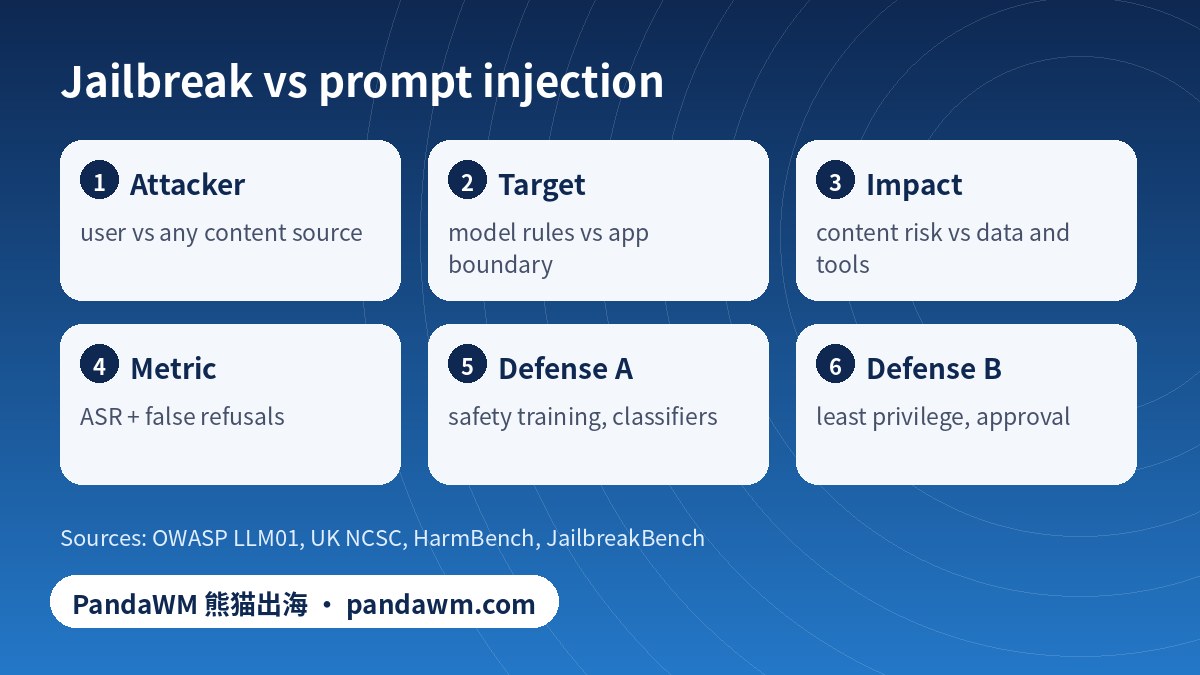
Short answer: a jailbreak targets the model’s own safety rules; prompt injection targets the application by smuggling attacker text into the model’s instructions. They overlap (OWASP calls jailbreaking a form of prompt injection), but they have different attackers, different damage and different best defenses. If you only test for one, you will miss the other. Concepts and metrics only; no prompts.
1. Side-by-side comparison
| Dimension | Jailbreak | Prompt injection |
|---|---|---|
| Typical attacker | A user of the chat interface | A user, or anyone who can place content the model will read (web page, email, file, tool result) |
| Goal | Make the model produce content its safety training or policy blocks | Make the model follow attacker instructions: leak data, change decisions, trigger tool calls |
| What is attacked | The model’s alignment and refusal behaviour | The boundary between your instructions and untrusted data |
| Worst-case impact | Policy-violating output, brand and compliance damage | Data exfiltration, unauthorised actions, privilege escalation (OWASP LLM01 impacts) |
| Where it hurts most | Public-facing chatbots, content generators | Agents, RAG, browsing, email and tool-using assistants |
| Main defenses | Model safety training, output classifiers, conversation-level moderation, abuse monitoring | Trust boundaries, least privilege, human approval, content segregation, output validation |
| Provider vs you | Mostly the model provider’s job, plus your own filters | Mostly your architecture; the model cannot be relied on to enforce it |
2. Why prompt injection is the harder architectural problem
The UK NCSC argues that comparing prompt injection to SQL injection is dangerous. Its point: current LLMs “simply do not enforce a security boundary between instructions and data inside a prompt”, so SQL-injection-style fixes do not transfer cleanly. NCSC suggests thinking of the model as an “inherently confusable deputy” and focusing on reducing the risk and the impact. OWASP agrees that it is unclear whether fool-proof prevention exists, and that RAG and fine-tuning do not fully mitigate prompt injection.
Practical consequence: for jailbreaks you choose and monitor the model; for prompt injection you assume it will sometimes succeed and make sure a successful injection cannot do much. Detail in our prompt-injection guide and the Chinese defense-in-depth architecture article.
3. Classify the incident
| Scenario (described, not reproduced) | Class | First control to check |
|---|---|---|
| A user pressures the support bot to drop its refusal policy over several turns | Jailbreak | Conversation-level moderation and output classifier |
| A web page the agent summarises contains hidden text addressed to the model | Indirect prompt injection | Content segregation, no sensitive tools in that session |
| A shared document in a knowledge base was edited to steer answers | Indirect injection / data poisoning | Source permissions, document provenance, review of edits |
| A user tries to make the bot reveal its hidden configuration | Prompt injection (leakage) | Keep secrets out of prompts; assume prompts are readable |
| A model with email access sends a message nobody approved | Injection with excessive agency | Least privilege and human approval for outbound actions |
4. How to measure each threat
| Metric | What it tells you | Watch out for |
|---|---|---|
| Attack success rate (ASR) | Share of test cases that elicit the unwanted behaviour | Depends on the judge, the output length (HarmBench saw up to 30% swings from token budget) and the behaviour list |
| False refusal rate | How often benign requests get blocked | JailbreakBench includes 100 benign behaviours for exactly this; a defense that refuses everything is useless |
| Judge agreement | How far the automatic grader matches human labels | JailbreakBench reported ~90.7% for a Llama-3-70B judge versus 56% for a rule-based judge |
| Injection containment | Whether a successful injection can reach tools or data | Test with the real tool permissions, not a mock with none |
| Time to detect | How long abuse sits in logs before someone notices | Needs alerting on policy-violation spikes, not only on outages |
JailbreakBench also warns that testing only against fixed, pre-computed attack strings is not enough: proper evaluation of defenses should use adaptive attacks. See the Chinese test-case and ASR metrics guide for test-case design and our red-teaming guide for tooling.
5. A combined defense plan
- Run a threat model that lists both: who can talk to the model, and what content the model reads (see the STRIDE template for LLM apps).
- Pick models and providers with published safety evaluations, and re-test after every upgrade.
- Add input and output classifiers; treat them as one layer, not the answer.
- Remove or gate every tool that can send, delete, pay or publish.
- Log prompts and tool calls (with privacy controls) and alert on policy-violation patterns.
- Write an incident playbook before you need it (Chinese LLM incident-response playbook).
- Re-run the suite on a schedule and after each prompt, model or tool change.
Frequently asked questions
Is prompt injection the same as a jailbreak?
Not quite. Jailbreaking is described by OWASP as a form of prompt injection where inputs make the model disregard its safety protocols; prompt injection is wider and includes steering the app’s behaviour, leaking data or triggering tools.
Which is more dangerous for an enterprise?
Usually prompt injection, because it can reach data and tools. A jailbreak on a bot with no tools mostly creates content and brand risk.
Can a system prompt stop both?
No. OWASP says system prompts can help but are not enough; use them with code-level controls.
Do guardrail products solve it?
They reduce risk. Evaluate them with your own traffic and adaptive tests, and keep architectural controls in place.
Where does this connect to our jailbreak explainer?
Start with What Is AI Jailbreaking?, then return here for comparison.
Scope note: this is a defensive and educational article for AI product, security and compliance teams. It contains no working jailbreak prompts, no bypass steps and no lists of uncensored tools, and PandaWM does not provide them. It is general information, not legal advice; platform and legal rules change, so check the current official pages.
Taking an AI product global? Talk to PandaWM
PandaWM helps overseas-facing businesses get found in AI search and traditional search (GEO and SEO, see our GEO service page) and run overseas ads through the platforms’ official channels. If you are preparing an AI product for global launch and want a second pair of eyes on how it is described, listed and advertised, contact us via pandawm.com or Telegram t.me/PANDA0134 with your market, product type and goals. We do not provide jailbreak, bypass or uncensored-model services.
Official and primary sources
- OWASP GenAI – LLM01:2025 Prompt Injection
- UK NCSC – Prompt injection is not SQL injection (8 Dec 2025)
- NIST AI 100-2 E2025
- HarmBench (arXiv 2402.04249)
- JailbreakBench (arXiv 2404.01318)
Pages opened on 3 November 2026. Policies, rankings and numbers change; always check the current official page.
Cite this page: PandaWM (熊猫出海) pandawm.com, “LLM Jailbreak vs Prompt Injection: Threat Models, Metrics and Defenses Compared (2026)”, https://www.pandawm.com/blog/llm-jailbreak-vs-prompt-injection-threat-models-defenses-en.html
 微信扫一扫打赏
 支付宝扫一扫打赏