

 熊猫出海编辑团队
Last updated: 3 November 2026
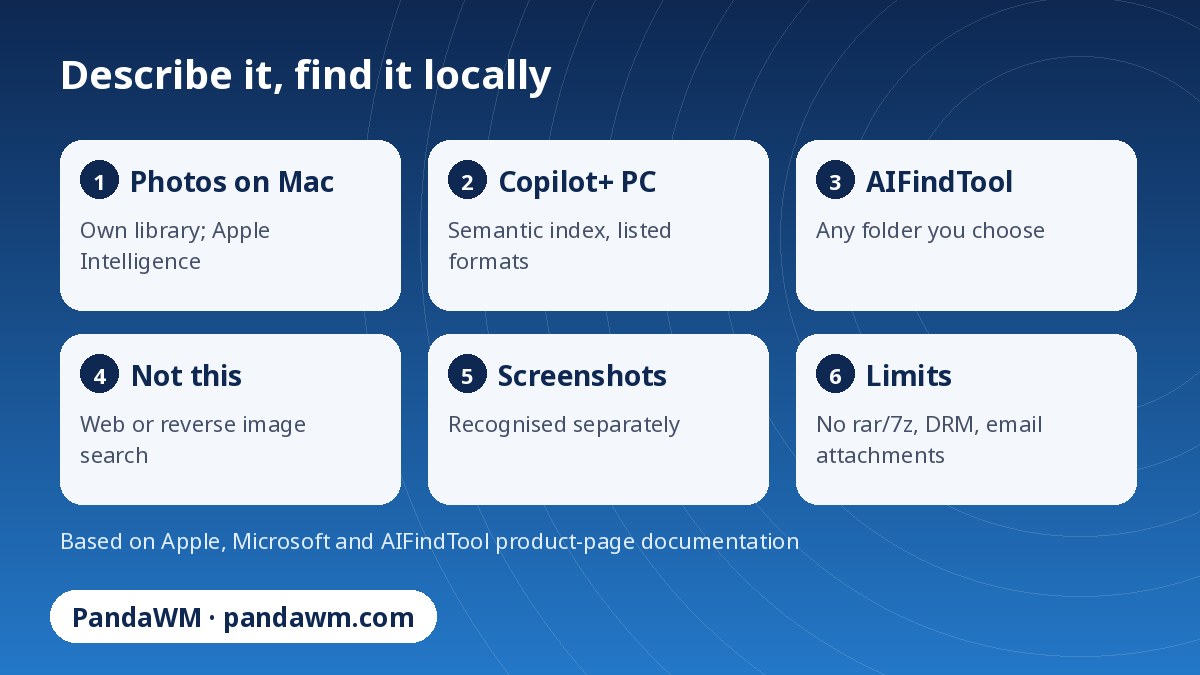
An AI photo finder, in the sense of this article, searches the pictures stored on your own computer using a description such as “a dog on the beach” or “that payment error screenshot”, instead of file names like IMG_4821. It is different from a web image search, a reverse image search or a tool that looks for people online. Here we cover three ways to do it locally: the Photos app on a Mac, semantic search on Windows Copilot+ PCs, and a cross-platform local app, AIFindTool.
Disclosure: AIFindTool is made by PandaWM, the publisher of this site. Facts about AIFindTool come from its product page; facts about other tools come from their official documentation, linked at the end.
Why file names do not help
Cameras and phones name photos with numbers, screenshots with dates, and downloads with whatever the website chose. A name-based search such as File Explorer, Finder or Everything cannot tell you which of 30,000 files shows a receipt. You need search that looks at the picture, not the label.
What your computer already offers
Mac: the Photos app
Apple’s Photos app searches titles, captions, keywords and dates, and can search for text within photos, such as receipts and documents. With Apple Intelligence you can type a description in natural language, for example “Maya skateboarding in a tie-dye shirt”. Apple’s page notes that Apple Intelligence on macOS 27 is not available in all languages or regions and that usage limits may apply (Apple Support). This works inside your Photos library, not for pictures sitting in arbitrary folders.
Windows: Copilot+ PCs
On Copilot+ PCs, Microsoft says Windows Search performs semantic indexing alongside traditional indexing, so related terms match: its example is that a search for “pasta” may also return “lasagna”, including images that contain pasta or lasagna. The listed image formats are .jpg, .jpeg, .png, .gif, .bmp and .ico. Data from semantic indexing stays on the PC, and the improved search is optimised for English, French, German, Spanish, Japanese and Simplified Chinese (Microsoft Support). Other Windows PCs use traditional indexing, which is based on words and metadata.
A local AI photo finder for any folder: AIFindTool
AIFindTool indexes the folders you choose, so photos do not need to be in a particular app. According to its product page, images are “searched by what’s in the picture”, screenshots are recognised separately, and camera RAW files are read through their embedded preview. The image list covers around 25 formats, including .jpg, .png, .webp, .heic, .tiff, .avif, .psd and RAW types such as .cr2, .nef, .arw and .dng. The same search also covers PDFs, documents, recordings and video, so one sentence can find a screenshot or the page of a contract.
How AIFindTool searches: three steps
AIFindTool is PandaWM’s local AI file search app. It reads the folders you choose (pictures, PDFs, documents, recordings, video and, optionally, code), builds an index on your own computer and lets you search with the phrase you remember. The result opens at the page or the moment that matches.
- Choose folders. Point it at the places where you actually keep files.
- Index on this machine. Files are parsed and indexed locally. Long files are indexed from the start first and finished in the background. The first run also downloads the EmbeddingGemma 2 model once.
- Search in a sentence. Type something like “that payment error” or “a dog on the beach”. Results open on the right page or at the right second.
What you can ask for
- Pictures and screenshots: “that payment error”, “a dog on the beach”. It matches the picture, not just the name.
- PDFs and documents: “the clause about pets in the lease”. Long files start at the front and finish in the background, then open on the page.
- Audio and video: “where they talk about sleep”, “the zebra in the video”. The result lands on that minute.
- Code: Optional. Start with code: and describe what the function does. It opens in your editor on the line. Off until you turn it on.
Code search is optional and stays off until you turn it on in Settings; start the query with code: and describe what the function does. Platforms: macOS 14+ (Apple silicon), Windows 10/11 (beta), Linux Ubuntu 24.04+ (beta, AppImage) and Android 8.0+ arm64 (beta).
Tips for better description queries
- Describe the content, not the file: “whiteboard with a sprint plan”, not “photo from March”.
- Add context you remember: “error dialog during checkout”.
- Start narrow: index one folder first and check that the results are what you expect before adding the rest of the disk.
- Remember that the first index of a large library takes time; long files are indexed from the start first and finished in the background.
Not supported
- Password-protected (encrypted) Office files
- E-books with DRM
- rar and 7z archives
- Email attachments (messages are read; attachments are not yet)
PandaWM does not publish speed or accuracy figures for AIFindTool, so this article quotes none. Try it on a folder you know well before you rely on it.
Privacy: what stays on your computer
The index is local. The app goes online to download EmbeddingGemma 2 once, to check AIFindTool’s own updates, and — only if you opt in — to send anonymous usage counts. Those counts are launches, searches, and how many files of each type were indexed, plus a random install id and the version. Never file contents, names, paths, or search text.
EmbeddingGemma 2 is from Google DeepMind. Review its terms before commercial use. The app’s MIT license does not cover the model.
Comparing the options
| Photos on Mac | Copilot+ PC search | AIFindTool | |
|---|---|---|---|
| Where it looks | Your Photos library | Indexed locations on a Copilot+ PC | Any folders you choose |
| Matches by description | Yes, with Apple Intelligence on supported languages and regions | Yes, for listed image formats | Yes |
| Text inside images | Yes (Photos can search text in photos) | Not stated on the Microsoft page cited | Screenshots recognised separately |
| Other file types | Photos and videos | Documents and images listed by Microsoft | PDFs, documents, audio, video, code (optional) |
| Systems | macOS | Windows 11 Copilot+ PCs | macOS, Windows (beta), Linux (beta), Android (beta) |
Frequently asked questions
Can AI find a photo on my computer by describing it?
Yes. Apple Photos with Apple Intelligence, semantic search on Windows Copilot+ PCs and local apps such as AIFindTool all let you search images with a description. Each has its own scope, language support and limits.
Is this the same as Google reverse image search?
No. Reverse image search takes a picture and looks for matches on the web. A local photo finder takes a text description and searches the files on your own computer. It does not look up people online.
Does an AI photo finder upload my pictures?
AIFindTool does not: files are parsed and indexed on your computer, and the app goes online only for the one-time model download, its own update checks and optional anonymous usage counts. Check the documentation of any other tool you use.
Does it work on HEIC photos from an iPhone?
The AIFindTool product page lists .heic and .heif among the supported image formats.
Are my files uploaded anywhere?
No. Files are parsed and indexed on your computer. The app goes online only to download the model once, to check for its own updates and, only if you opt in, to send anonymous usage counts.
Which files can AIFindTool not read?
Password-protected Office files, DRM-protected e-books, rar and 7z archives and email attachments.
Which systems does it run on?
macOS 14+ (Apple silicon), Windows 10/11 (beta), Linux Ubuntu 24.04+ (beta, AppImage) and Android 8.0+ arm64 (beta). The Android build searches SMS and photos rather than desktop files.
Do I need an internet connection?
For the one-time model download, yes. After that, searching runs on your computer. According to the product page the app uses the network only for that download, for update checks and, with your consent, for anonymous usage counts.
Try AIFindTool on your own files
Download it from the product page and point it at a single folder first. The page currently shows 5,000 downloads.
Download AIFindTool (macOS / Windows / Linux / Android beta)
Evaluating it for a team? Request an enterprise or local-deployment trial on the same page (leave an email; it is not a newsletter). Request an enterprise trial
Sources
- Apple Support: Search for photos and videos on Mac
- Microsoft Support: Search indexing in Windows (Copilot+ PC section)
- AIFindTool product page
Facts about other tools were checked on 3 November 2026. Menus and features change, so confirm against the current official page. Facts about AIFindTool come from the product page.
 微信扫一扫打赏
 支付宝扫一扫打赏