
 熊猫出海编辑团队
Last updated: 13 November 2026. All prices checked on the vendors’ official pages that day.
In AI, a token is the small unit of text a language model reads and writes. Models do not see words or letters directly; a tokenizer splits text into pieces, which can be a whole word (“cat”), part of a word, a number, a space or a punctuation mark. Every model API, from OpenAI to Gemini, measures context limits and bills usage in tokens. So if you want to understand what AI costs, you first need to understand tokens.
Note: “AI token” can also mean a cryptocurrency. This article is only about tokens in large language models (LLMs).
What is a token in AI, exactly?
A tokenizer has a fixed vocabulary of pieces. Common words are usually one token; long or rare words are broken into several; Chinese, Japanese and code often produce more tokens per character than plain English. Google’s documentation puts it simply: tokens can be single characters like “z” or whole words like “cat”, and the set of all tokens is the model’s vocabulary (Google: count tokens).
How many words is a token?
| Rule of thumb (vendor docs) | Source | Use it for |
|---|---|---|
| 1 token ≈ 4 characters; 100 tokens ≈ 60–80 English words | Google (Gemini) | Quick English estimates |
| 1M tokens ≈ 555K words or 2.5M characters (newer tokenizer) | Anthropic (Claude 4.7+) | Long documents on Claude |
| Newer Claude tokenizer: about 30% more tokens than before | Anthropic | Migrating prompts between models |
| 1 English character ≈ 0.3 token; 1 Chinese character ≈ 0.6 token | DeepSeek | Chinese-language estimates |
| Do not estimate images and files by characters; use the counting API | OpenAI | Multimodal prompts |
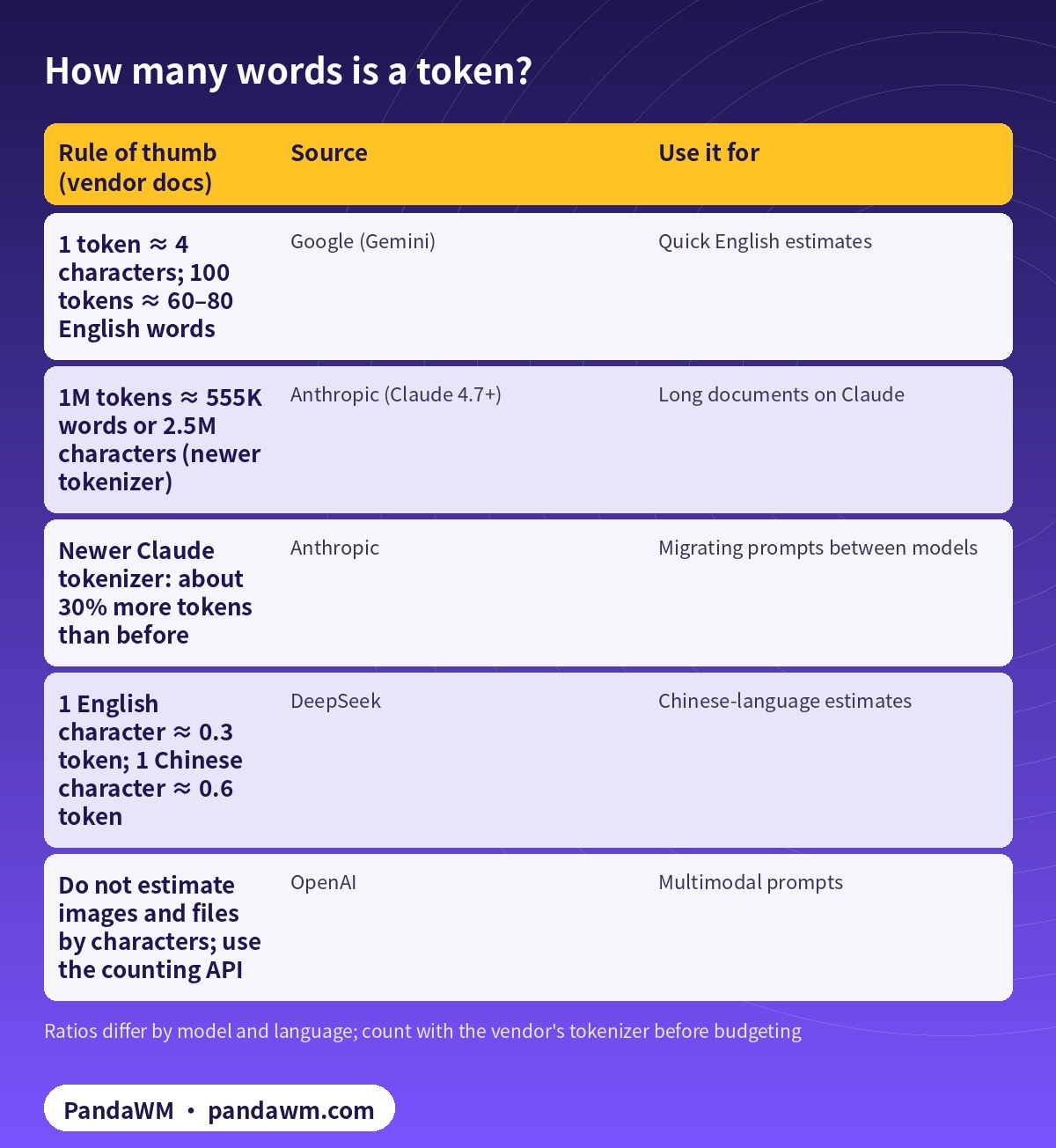
These ratios are useful for a first budget, but they are not interchangeable. The same paragraph can be a different number of tokens on GPT, Claude and Gemini, and even between two versions of the same vendor’s models. Anthropic, for example, says its tokenizer introduced with Claude Opus 4.7 produces about 30% more tokens for the same text (token counting). Before you commit to a budget, count real prompts with each vendor’s counting endpoint: OpenAI’s input token count endpoint, Anthropic’s token counting API or Gemini’s countTokens.
Input, output, cached and reasoning tokens
| Token type | What it is | How it is billed |
|---|---|---|
| Input tokens | Your prompt: instructions, history, documents, tool definitions | Input price |
| Cached input tokens | Repeated prompt prefixes served from cache | Much lower than input (often 0.1× or less) |
| Output tokens | The model’s answer | Output price, usually 4–6× input |
| Reasoning / thinking tokens | Hidden reasoning before the answer | Billed as output |
| Tool and search tokens | Retrieved content fed back to the model | Input price, plus any per-call tool fee |
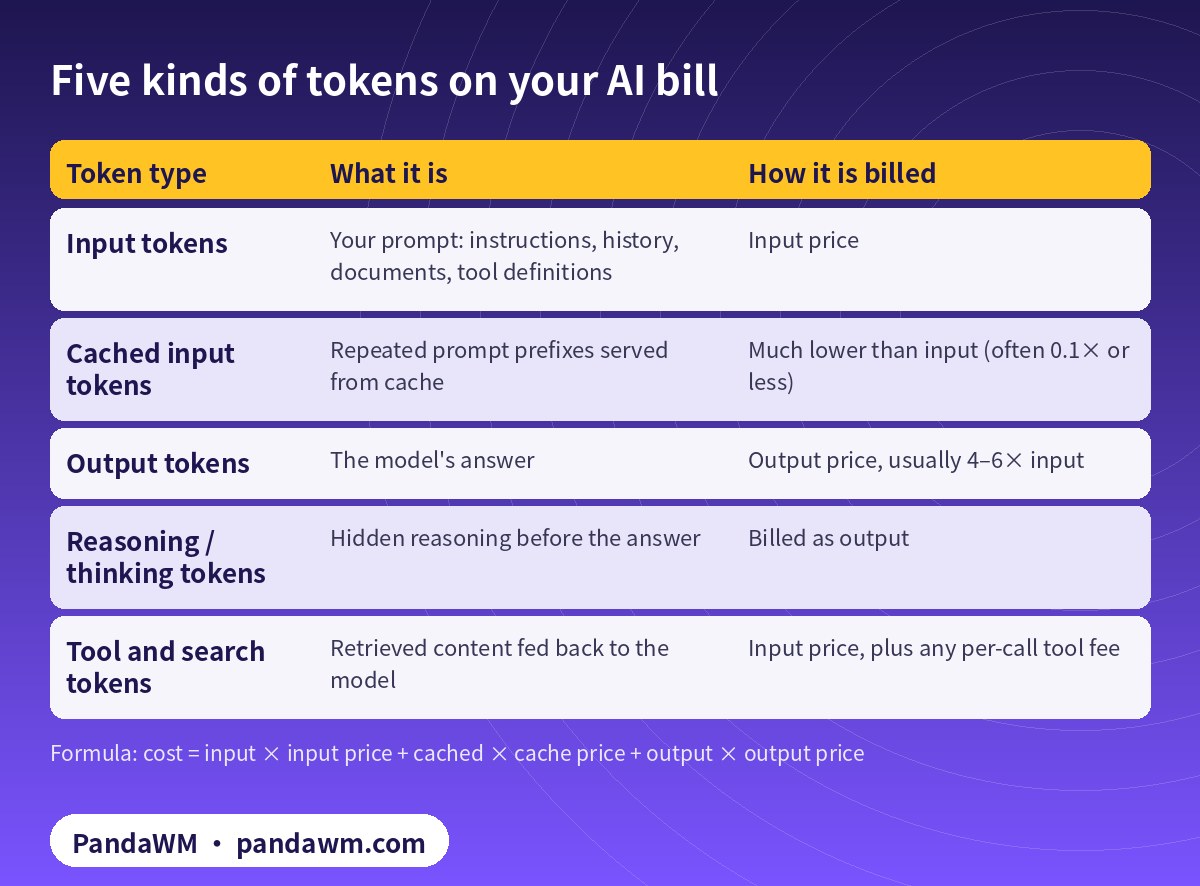
Two points surprise most first-time buyers. First, output is several times more expensive than input: gpt-6.1-terra charges $1 per 1M input tokens and $5 per 1M output tokens. Second, reasoning models bill their hidden thinking as output, so a short visible answer can still use thousands of output tokens. Google states this explicitly for Gemini (“output price including thinking tokens”).
How to calculate AI token cost
The formula is the same for every vendor:
Monthly cost = (uncached input tokens × input price) + (cached input tokens × cache price) + (output tokens × output price), with prices quoted per 1 million tokens.
Example: a support assistant handles 20,000 conversations a month, each with about 2,000 input tokens and 400 output tokens. That is 40M input and 8M output tokens. On gpt-6.1-terra at Standard prices: 40 × $1 + 8 × $5 = $80. On Claude Sonnet 5.5: 40 × $2 + 8 × $10 = $160. On gpt-6-luna: 40 × $0.10 + 8 × $0.50 = $8.
AI token calculator
Token cost calculator
Full price lists: OpenAI, Claude, Gemini and the cross-vendor comparison.
Why tokens matter beyond cost
- Context window: the maximum tokens a model can take in one request (for example 1M tokens on Claude Opus 5.5 and Gemini 4 Hydrogen). Long chat histories eat into it.
- Output limit: the maximum tokens in one answer (128K on Claude Opus 5.5 and chat-latest).
- Rate limits: vendors cap tokens per minute as well as requests per minute.
- Latency: more output tokens means a longer wait.
Five ways to use fewer tokens
- Trim system prompts and examples; every request pays for them.
- Summarise or truncate long conversation histories.
- Retrieve only relevant passages instead of sending whole documents.
- Ask for concise output formats and set a max output length.
- Keep stable prompt prefixes so they hit the cache.
Tokens for businesses: buying and managing them
For a company, “buying tokens” really means holding an account with a model vendor (or a unified API) and paying for usage. The hard parts are usually procurement and control: who owns the account, how keys are issued, how spend is capped and how usage is reported per product or client. That is what Token as a Service refers to. PandaWM helps companies open and manage their own official accounts, or connect through a compliant unified API: Overseas AI Token service: account setup + API access (PandaWM).
FAQ
What is a token in ChatGPT?
The same thing: a piece of text the model processes. ChatGPT’s models count your messages and their replies in tokens; in the API you pay per token.
How many tokens is 1,000 words?
Very roughly 1,250–1,670 tokens in English by Google’s 60–80 words per 100 tokens rule, and more on tokenizers that split text more finely. Count with the vendor’s tool for accuracy.
Are Chinese characters more expensive in tokens?
Often. DeepSeek estimates about 0.6 token per Chinese character versus 0.3 per English character, and other tokenizers differ again.
Do spaces and punctuation count as tokens?
Yes, they are part of tokens or tokens on their own.
Why is my output token count higher than the answer length?
Reasoning (thinking) tokens are counted and billed as output.
Is an AI token the same as a crypto token?
No. LLM tokens are units of text; crypto tokens are digital assets. This guide covers only LLM tokens.
Compliance note: Each model vendor only serves customers in its supported countries and regions and requires accurate account, identity and billing information. PandaWM helps companies use AI models through their own accounts or overseas entities that are legitimately established in supported regions, or through a compliant unified API. We do not sell, rent, share or transfer accounts or API keys, and we do not help anyone bypass regional restrictions, KYC, sanctions or payment controls. We are not an official partner or reseller of OpenAI, Anthropic, Google or any other vendor. Prices on this page are the vendors’ public list prices, not PandaWM prices.
Related guides
- Overseas AI Token service: account setup + API access (PandaWM)
- Token as a Service (TaaS) for business
- LLM API pricing comparison: cheapest providers
- OpenAI API pricing (GPT-6) + cost calculator
- Claude API pricing: Opus, Sonnet, Haiku
- Gemini API pricing, free tier and billing tiers
- OpenRouter pricing and API key guide
- 繁體中文:AI Token 是什麼?
- 简体中文:Token 计算器与大模型 API 价格对比
Talk to PandaWM about overseas AI Token access
Tell us which models you need (GPT, Claude, Gemini or others), your expected monthly token volume, where your company and any overseas entity are registered, and whether you prefer your own vendor accounts or one unified API. We help companies open and manage their own official accounts (billing, keys, usage controls) or connect through a compliant unified API. We do not sell, rent or share accounts, and we are not an official reseller of any model vendor.
WhatsApp: +852 5904 8602Telegram: @PANDA0134WeChat: szcwh99

Official sources
- Google: understand and count tokens
- Anthropic: token counting
- Anthropic: Claude models overview
- OpenAI: counting tokens
- DeepSeek API: token & token usage
- OpenAI API pricing
All official pages checked on 2026-11-13. Prices are in USD per 1 million tokens (MTok), before tax. Vendors change prices; the official pages prevail.
 微信扫一扫打赏
 支付宝扫一扫打赏