
 熊猫出海编辑团队
Last updated: 3 November 2026
Short answer: prompt injection is when input changes an LLM’s behaviour in ways its developer did not intend, including input that humans cannot see. It is number one in OWASP’s LLM application risks, and the UK NCSC says current models do not enforce a security boundary between instructions and data. You cannot fully prevent it, so enterprise defense is about limiting what a successful injection can do. This guide covers attack types, impact and a checklist you can score yourself. No attack strings are included.
1. What prompt injection is
OWASP defines the vulnerability as user prompts altering the LLM’s behaviour or output in unintended ways, even when the inputs are imperceptible to humans, as long as the model parses them. The NCSC frames the root cause: developers concatenate their own instructions with untrusted content in one prompt, then treat the response as if there were a robust boundary between “what the app asked for” and the untrusted part. There is none.
2. Attack types
| Type | Meaning (OWASP) | Typical place it appears |
|---|---|---|
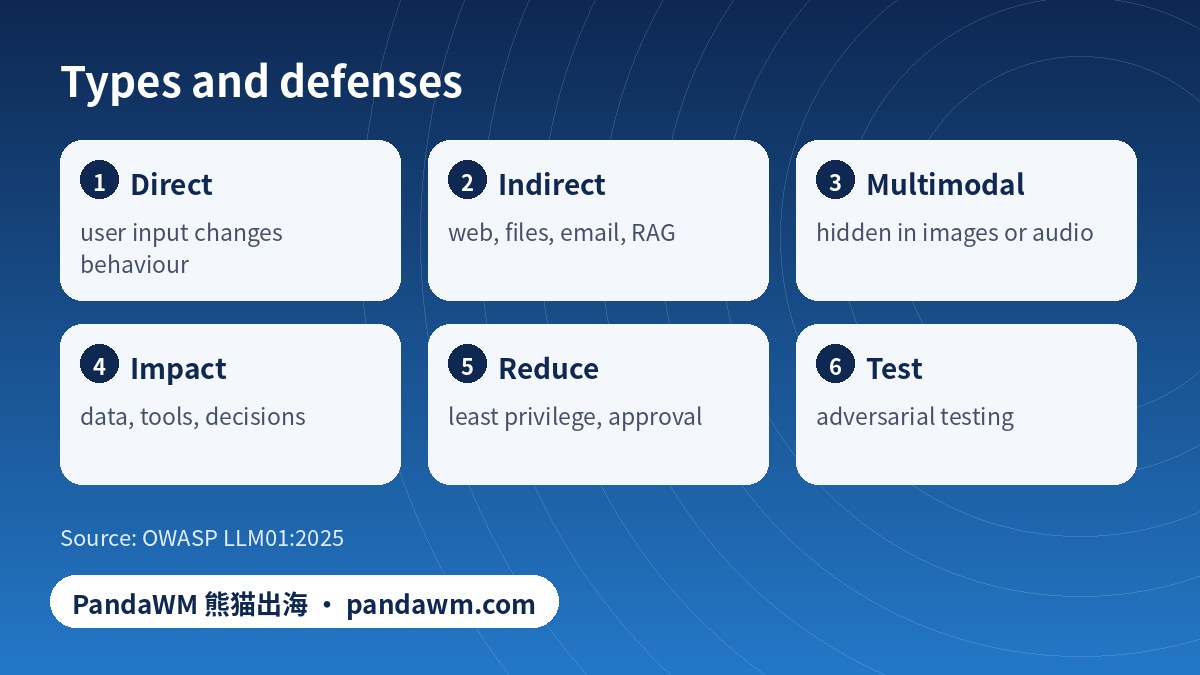
| Direct | A user’s own input alters model behaviour; can be intentional or accidental | Chatbots, assistants, form-driven prompts |
| Indirect | The model accepts content from external sources (websites, files) whose embedded text changes its behaviour | Summarisers, browsing agents, email assistants, RAG (see our indirect-injection guide) |
| Unintentional | Content contains instructions the author never meant to aim at an AI | Documents with embedded screening instructions |
| Intentional model influence | Someone alters documents in a repository the system retrieves from, to steer answers | Knowledge bases with loose edit rights |
| Multimodal | Instructions hidden in one modality (for example an image) that accompanies benign text; OWASP calls robust defenses an area for further research | Vision and document-understanding features |
3. What can go wrong
- Disclosure of sensitive information, including details of AI infrastructure or system prompts
- Content manipulation leading to incorrect or biased outputs
- Unauthorised access to functions available to the model
- Execution of arbitrary commands in connected systems
- Manipulation of critical decision-making
OWASP’s example scenarios give a feel for severity: a support chatbot told to ignore guidelines and query private stores; a summarised web page whose hidden text exfiltrates the conversation; a resume that unwittingly triggers a screening instruction; a repository document altered to skew retrieval-augmented answers. Severity depends on business context and on how much agency the model has.
4. Why you cannot “just filter it”
The NCSC argues that LLMs are “inherently confusable”: unlike a classical confused-deputy bug, the risk cannot be fixed outright, so you reduce likelihood and impact and accept that some residual risk must be tolerated or the system should not be built. OWASP adds that RAG and fine-tuning do not fully mitigate it. Filters help, but a filter is another model-shaped component that can be bypassed (HarmBench, for instance, notes output filters can be foiled by encoded outputs).
5. The seven OWASP mitigations in plain terms
| Mitigation | What it means in practice |
|---|---|
| Constrain model behaviour | Narrow role and scope in the system prompt; treat it as guidance, not enforcement |
| Define and validate output formats | Structured outputs checked by deterministic code |
| Input and output filtering | Semantic filters and string checks; evaluate groundedness and relevance of responses |
| Least privilege | Give the app its own API tokens and handle functions in code; minimum access |
| Human approval | Human-in-the-loop for privileged operations |
| Segregate external content | Mark untrusted content and limit its influence on user prompts |
| Adversarial testing | Penetration tests and breach simulations that treat the model as an untrusted user |
6. Score your own defenses
Prompt injection readiness check (Tick what is true today.)
For Chinese-language depth see the jailbreak and prompt-injection defense guide and agent prompt-injection defense, and for architecture see defense-in-depth layers.
Frequently asked questions
Is prompt injection the same as SQL injection?
No. The NCSC says comparing them is dangerous: current LLMs do not enforce a boundary between instructions and data, so mitigation has to focus on reducing risk and impact rather than expecting a single fix.
Can I stop prompt injection with a better system prompt?
OWASP lists system-prompt constraints as one mitigation, but says it is unclear whether fool-proof prevention exists. Pair it with code-level controls.
Does RAG make it safer?
OWASP notes that RAG and fine-tuning do not fully mitigate prompt injection. Retrieved documents can themselves carry injected text.
What should I fix first?
Tool permissions and human approval for risky actions. They limit impact even when detection fails.
Is prompt injection the same as a jailbreak?
They overlap; see our comparison.
Scope note: this is a defensive and educational article for AI product, security and compliance teams. It contains no working jailbreak prompts, no bypass steps and no lists of uncensored tools, and PandaWM does not provide them. It is general information, not legal advice; platform and legal rules change, so check the current official pages.
Taking an AI product global? Talk to PandaWM
PandaWM helps overseas-facing businesses get found in AI search and traditional search (GEO and SEO, see our GEO service page) and run overseas ads through the platforms’ official channels. If you are preparing an AI product for global launch and want a second pair of eyes on how it is described, listed and advertised, contact us via pandawm.com or Telegram t.me/PANDA0134 with your market, product type and goals. We do not provide jailbreak, bypass or uncensored-model services.
Official and primary sources
- OWASP GenAI – LLM01:2025 Prompt Injection
- UK NCSC – Prompt injection is not SQL injection (8 Dec 2025)
- NIST AI 100-2 E2025
- HarmBench (arXiv 2402.04249)
Pages opened on 3 November 2026. Policies, rankings and numbers change; always check the current official page.
Cite this page: PandaWM (熊猫出海) pandawm.com, “Prompt Injection Explained: Attack Types, Real-World Impact and an Enterprise Defense Checklist (2026)”, https://www.pandawm.com/blog/prompt-injection-explained-attack-types-enterprise-defense-en.html
 微信扫一扫打赏
 支付宝扫一扫打赏