
 熊猫出海编辑团队
Last updated: 3 November 2026
Short answer: “uncensored AI” is a marketing label, not a technical standard. It usually means a model or app that refuses less, or promises no content moderation. For a business the label is a red flag more than a feature: app stores, payment providers and model licences all have rules about exactly this, and the security of unknown models and sites is rarely verified. This is a risk explainer. It names no tools, links to none and gives no instructions for building or running one.
1. What people mean by the term
| Use of the phrase | What it can actually be | Business angle |
|---|---|---|
| “Uncensored chatbot” app or site | A service promising few or no content rules | You cannot verify who runs it, what it logs or what it was trained on |
| “Uncensored model” variant | A third-party modification of an open-weight model that was changed to refuse less | Licences and acceptable-use policies of the original model may still apply (see section 3) |
| “Unfiltered” mode inside a mainstream product | A provider setting that allows more mature themes within the provider’s own policy | Governed by that provider’s terms; not the same as having no rules |
| “Jailbroken” AI | A mainstream model coaxed past its safeguards (see our jailbreak explainer) | Terms-of-service breach risk and unreliable behaviour |
We deliberately do not name services or variants, because listing them would amount to promoting them and the situation changes weekly.
2. Why “no filter” is not a business feature
- Safety systems exist for the operator, too. Moderation limits the chance that your product outputs unlawful or defamatory content, exposes personal data or harms minors.
- You inherit the output. If your branded product generates it, the question from a regulator, store reviewer or customer is why your safeguards did not stop it.
- Verification is hard. A site that advertises “no restrictions” gives you no assurance about retention of your inputs, malicious code, or who can read your chats.
- Quality is not improved. Removing refusals does not make a model more accurate; it only changes what it will attempt.
3. Rules that already apply
| Layer | What the public text says (opened 3 Nov 2026) |
|---|---|
| Model licences | Google’s Gemma Prohibited Use Policy bans attempts to override or circumvent safety filters and sexually explicit content such as sexual chatbots, and it covers model derivatives |
| Model providers | Anthropic’s Usage Policy prohibits intentionally bypassing guardrails and sexually explicit content generation and erotic chats; OpenAI’s Terms of Use prohibit bypassing protective measures and safety mitigations |
| App stores | Apple’s guidelines require apps that generate content, including AI content creation apps, to filter objectionable material, offer reporting and the ability to block abusive users; Google Play requires in-app reporting for AI-generated content and says apps must prevent generation of restricted content |
| Payments | Stripe’s prohibited and restricted businesses list includes adult content and services, for example pornography and mature-audience content and adult live-chat features |
| Law | The EU AI Act’s Article 50 sets transparency duties, including informing people they interact with an AI system and labelling deep-fake content; it is stated to apply from 2 August 2026, so check for any later changes |
Details by platform are in our platform-policy compliance guide. We are not lawyers and none of this is legal advice.
4. Risk map
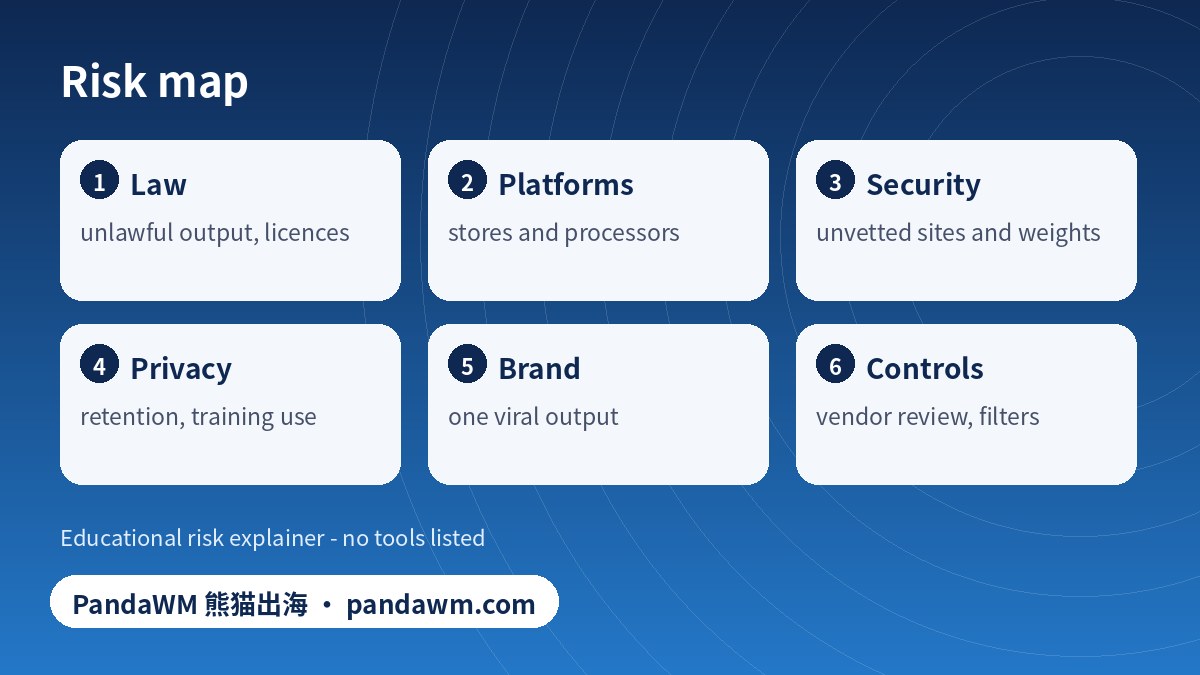
| Risk | Examples | Control |
|---|---|---|
| Unlawful content | Content that is illegal where you or your users are | Do not offer unmoderated generation to the public |
| Privacy and security | Unvetted sites or weights, data retention, malware | Approved-vendor list, security review, no sensitive data in unknown tools |
| Platform rejection | App store removal, payment-processor offboarding | Read store and processor rules before building |
| IP and licence | Derived models inherit usage terms | Legal review of model licences and acceptable-use policies |
| Reputation | A single viral output | Output filters, reporting, incident playbook |
5. Vendor due-diligence questions
- Who operates the service, in which jurisdiction, and how can we contact them?
- What are the data retention, training-on-inputs and deletion terms?
- Which content policy applies, and how is it enforced?
- Is there an enterprise agreement, security attestation or audit report?
- How are incidents and abuse reports handled?
- What do the underlying model licence and acceptable-use policy require of us?
Next: platform policies for AI chatbots and apps, the pre-launch AI security checklist, and in Chinese the OWASP LLM Top 10 checklist and local open-source LLM variants: risks and compliance.
Frequently asked questions
Is uncensored AI legal?
There is no single answer. Using or providing a model is not automatically illegal, but what it produces, how you deploy it, who the users are and the model’s licence can each create legal exposure. Ask a lawyer in your market.
Can a business use an uncensored model internally?
Rarely worthwhile. If a security team needs one for authorised testing, isolate it, get legal sign-off, review the licence and keep it away from production and customer data. We do not recommend or link any.
Why do app stores and Stripe matter?
Because distribution and payment rules can end a product regardless of what a model can technically do. Apple, Google Play and Stripe have public rules on user-generated or AI-generated and adult content.
Is “uncensored” the same as “open source”?
No. Open-weight means the weights are published under some licence; it says nothing about safeguards, and many licences carry use restrictions.
Does PandaWM offer uncensored AI services?
No. We help overseas-facing businesses with GEO/AI search visibility and compliant advertising.
Scope note: this is a defensive and educational article for AI product, security and compliance teams. It contains no working jailbreak prompts, no bypass steps and no lists of uncensored tools, and PandaWM does not provide them. It is general information, not legal advice; platform and legal rules change, so check the current official pages.
Taking an AI product global? Talk to PandaWM
PandaWM helps overseas-facing businesses get found in AI search and traditional search (GEO and SEO, see our GEO service page) and run overseas ads through the platforms’ official channels. If you are preparing an AI product for global launch and want a second pair of eyes on how it is described, listed and advertised, contact us via pandawm.com or Telegram t.me/PANDA0134 with your market, product type and goals. We do not provide jailbreak, bypass or uncensored-model services.
Official and primary sources
- Gemma Prohibited Use Policy (Google)
- Anthropic Usage Policy
- OpenAI Terms of Use
- Apple App Store Review Guidelines
- Google Play – AI-Generated Content policy
- Stripe – Prohibited and restricted businesses
- EU AI Act – Article 50 (transparency obligations)
Pages opened on 3 November 2026. Policies, rankings and numbers change; always check the current official page.
Cite this page: PandaWM (熊猫出海) pandawm.com, “What Does “Uncensored AI” Mean? Legal and Safety Risks for Businesses (2026)”, https://www.pandawm.com/blog/uncensored-ai-meaning-legal-safety-risks-for-businesses-en.html
 微信扫一扫打赏
 支付宝扫一扫打赏