

 熊猫出海编辑团队
Last updated: 3 November 2026
Short answer: AI jailbreaking means crafting inputs that push a language model into ignoring the safety rules its developer built in. OWASP describes jailbreaking as “a form of prompt injection where the attacker provides inputs that cause the model to disregard its safety protocols entirely”. For a business the point is not the trick itself but the exposure: policy violations, leaked data, account bans and brand damage. This guide explains the concept, the attack families at a high level, why attacks have a short shelf life, and what an AI product team should do. It contains no prompts and no bypass steps. (中文版见 AI 破甲、越狱与提示词注入术语对照。)
1. What “jailbreak” means for a language model
A modern chat model is trained to refuse some requests (for example help with serious harm) and to follow the operator’s instructions. A jailbreak is an attempt to make it do what it was trained, or configured, not to do. The word is borrowed from phone jailbreaking, but the analogy is loose: there is no single lock to pick, only a statistical model whose refusals can be more or less robust.
Security teams usually separate three ideas, which we compare in detail in our threat-model comparison:
- Jailbreak: defeating the model’s own safety training or policy (the model “disregards its safety protocols”).
- Prompt injection: getting the model to treat attacker-controlled text as instructions, which can be used to leak data or trigger tool actions (OWASP LLM01). See our prompt-injection guide.
- Adversarial attacks (NIST term): the broader family of attacks on ML systems, which NIST AI 100-2 E2025 organises by attacker goals, capabilities and life-cycle stage.
2. The main attack families (concepts only)
Public research groups the techniques so defenders can test against them. We describe categories, not recipes.
| Family | Idea in one line | What defenders look at |
|---|---|---|
| Persona and framing | Wrap a request in a fiction or role so the refusal looks out of place | Intent classification that ignores the wrapper; policy checks on the underlying ask |
| Obfuscation and encoding | Hide the request or the answer in a transformed form | Normalisation before checks; output classifiers that understand encodings |
| Multi-turn drift | Build up to a disallowed answer across many harmless-looking turns | Conversation-level moderation, not single-message checks |
| Long-context flooding | Bury the request in very long or repeated context | Context-length limits, position-robust safety training |
| Automated search | Use an optimiser or a second model to iterate on attempts | Rate limits, anomaly detection, adaptive red teaming |
| Indirect / injected | Plant instructions in documents, pages or tool results the model reads | Trust boundaries, least privilege, human approval (see section 5) |
The HarmBench paper compared 18 red-teaming methods against 33 models and defences and found that no attack or defense was uniformly effective, a reminder that both sides keep moving. JailbreakBench, an open benchmark of 100 harmful and 100 benign behaviours, exists for the same reason: to make results comparable and reproducible.
3. Why jailbreaks keep failing (and sometimes work)
Popular, copy-and-paste attacks have a short half-life because providers patch what circulates. In JailbreakBench’s own appendix, a well-known adversarial-suffix attack that worked on some GPT models later fell to roughly 5% success after safety patches (evaluation dated 5 June 2024). Anthropic reported that its Constitutional Classifiers cut jailbreak success on 10,000 synthetic test prompts from 86% to 4.4%, with a 0.38% rise in refusals that was not statistically significant and about 23.7% more compute. In the company’s public challenge, though, 339 participants spent roughly 3,700 hours and one universal jailbreak was eventually found, which is why Anthropic itself recommends complementary defences.
Takeaway: attacks and defences are a moving target. Treat any model as “hard to break, not unbreakable”, and design the product so that one failure is not catastrophic.
4. Why this is a business risk
| Risk | How it shows up | Who owns it |
|---|---|---|
| Policy and account | Provider terms prohibit bypassing safeguards; violations can lead to suspension or termination | Whoever holds the API key or workspace |
| Data exposure | Model coaxed into revealing system prompts, internal documents or customer data | Product and security team |
| Harmful output | Your branded assistant produces content that breaches law or platform rules | Product owner, legal |
| Store and payment rules | App stores and payment providers have rules on AI-generated content and adult content (see our platform-policy guide) | Product, compliance |
| Brand | Screenshots of a “broken” chatbot spread faster than the fix | Marketing, support |
Provider rules are explicit. Anthropic’s Usage Policy lists intentionally bypassing or interfering with guardrails (it names jailbreaking and prompt injection) as prohibited without prior authorisation, and carves out authorised security work such as bug bounty programs and its Cyber Verification Program. OpenAI’s Terms of Use say you may not bypass protective measures or safety mitigations in its services. See our ChatGPT account-risk article for how this plays out for ChatGPT accounts.
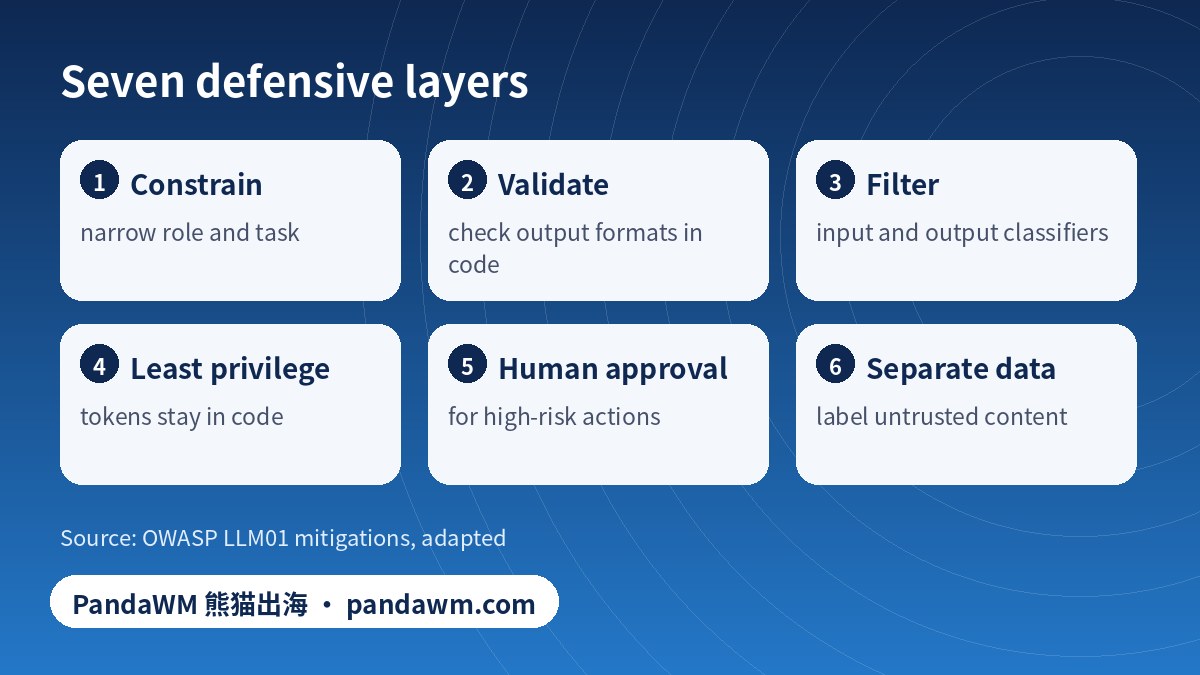
5. A seven-step defense checklist
Based on the mitigation list in OWASP LLM01, adapted for product teams:
- Constrain behaviour: give the model a narrow role and task in the system prompt, but never rely on it as a security control.
- Validate outputs: define expected formats and check them with deterministic code.
- Filter input and output: use moderation and classifier layers on both sides, including checks for encoded content.
- Least privilege: keep tokens and powerful functions in code, not in the model’s hands.
- Human approval for high-risk actions (payments, deletions, external messages).
- Separate untrusted content (web pages, files, emails) and label it as data.
- Test adversarially and keep testing: treat the model as an untrusted user, rerun your suite after each model or prompt change, and watch production logs.
For implementation detail in Chinese see the Chinese jailbreak and prompt-injection defense guide, agent prompt-injection defense and the OWASP LLM Top 10 checklist; for a full launch checklist see the pre-launch security checklist.
Frequently asked questions
Is jailbreaking an AI illegal?
Rules differ by country and by case, and we are not giving legal advice. Contractually, major providers prohibit bypassing their safeguards, and authorised security testing is handled through official programs. Using a model to produce content that is itself unlawful is a separate problem.
What does “jailbroken AI” mean?
A model or session whose safety behaviour has been defeated, so it answers things it would normally decline. It does not mean the model gained new abilities.
Is a jailbreak the same as prompt injection?
No. OWASP calls jailbreaking a form of prompt injection aimed at the model’s own safety rules; prompt injection more broadly is about attacker text being treated as instructions, often to leak data or misuse tools.
Can we make our model unjailbreakable?
No. OWASP says it is unclear whether fool-proof prevention exists, and HarmBench found no uniformly effective defence. Aim to reduce likelihood and limit impact.
Should we red-team our own product?
Yes, within your own systems and provider terms. See our AI red-teaming guide.
Scope note: this is a defensive and educational article for AI product, security and compliance teams. It contains no working jailbreak prompts, no bypass steps and no lists of uncensored tools, and PandaWM does not provide them. It is general information, not legal advice; platform and legal rules change, so check the current official pages.
Taking an AI product global? Talk to PandaWM
PandaWM helps overseas-facing businesses get found in AI search and traditional search (GEO and SEO, see our GEO service page) and run overseas ads through the platforms’ official channels. If you are preparing an AI product for global launch and want a second pair of eyes on how it is described, listed and advertised, contact us via pandawm.com or Telegram t.me/PANDA0134 with your market, product type and goals. We do not provide jailbreak, bypass or uncensored-model services.
Official and primary sources
- OWASP GenAI – LLM01:2025 Prompt Injection
- NIST AI 100-2 E2025 – Adversarial Machine Learning taxonomy
- HarmBench (arXiv 2402.04249)
- JailbreakBench (arXiv 2404.01318)
- Anthropic – Constitutional Classifiers (3 Feb 2025)
- Anthropic Usage Policy
- OpenAI Terms of Use
Pages opened on 3 November 2026. Policies, rankings and numbers change; always check the current official page.
Cite this page: PandaWM (熊猫出海) pandawm.com, “What Is AI Jailbreaking? Meaning, Why It Keeps Failing and the Business Risks (2026)”, https://www.pandawm.com/blog/what-is-ai-jailbreaking-meaning-risks-business-defense-en.html
 微信扫一扫打赏
 支付宝扫一扫打赏