

 熊猫出海编辑团队
Last updated: 2 November 2026
People searching for the best crypto payment gateway usually want a ranked list. We do not publish one. Fees, supported coins, payout countries and compliance rules differ by provider, change often and depend on your country and business type, so any “top 10” that quotes competitors’ fees is a snapshot at best and guesswork at worst. What we can give you is a method: 12 checks you can apply to any provider, including ours, plus a scorecard you can fill in during demos. Use it to compare crypto payment gateway for business offers on the same terms. If you first need the basics, start with crypto payment gateway vs crypto payment processor.
Compliance note: the PandaWM crypto payment gateway is operated by a Hong Kong company and serves merchants registered outside mainland China and their overseas customers only; it is not offered to mainland China residents. PandaWM holds an MSB (Money Services Business) license. Merchants remain responsible for the laws of the places where they operate and sell, and must expect identity (KYC), anti-money-laundering and sanctions checks. See our crypto payment compliance guide (Chinese). This article is general information, not legal, tax or investment advice.
Why “best” depends on your business
| Merchant type | What usually matters most |
|---|---|
| Online store (Shopify, WooCommerce) | Plugin quality, checkout languages, refund handling, fiat payout |
| SaaS or subscription | Invoicing, renewal reminders, API and webhooks, reconciliation |
| Games and digital goods | Web top-up flow, instant order matching, fraud controls, platform rules |
| B2B or cross-border trade | Large-payment handling, bank payout countries, documentation, KYC speed |
| Agencies and service businesses | Payment links, multi-user access, exports for accounting |
The 12-point checklist
1. Eligibility and licensing
Can the provider serve your country and business type? Which entity holds the funds, and is it registered or licensed as a money-services business where required? Ask for the legal entity name.
2. Coins and networks
Which coins and which networks are live today (for example, which chains carry USDT)? Get the list and the date it was confirmed.
3. Total cost
Add every layer: per-transaction fee, network fees, conversion spread, withdrawal fee, bank fee, monthly or setup fees. Run your real order sizes through it with our fee calculator (Chinese).
4. Settlement options
Keep crypto, convert to fiat, or both? Which currencies and which payout countries? How fast and how often?
5. Integration
Plugin for your platform, REST API, SDK, hosted payment page, payment links. Are docs public, and is there a sandbox for testing?
6. Checkout experience
Languages, mobile layout, QR codes, clear amount and network, countdown for price lock.
7. Security
2FA for merchants, role-based users, API key rotation, withdrawal whitelists, audit logs.
8. Under- and overpayments
What happens when a customer sends too little, too much, late or on the wrong network? Is there a documented rule and a merchant dashboard action?
9. Refunds and disputes
Crypto transfers are not reversible, so ask how refunds are issued, who pays the network fee and how refunds appear in reports.
10. Reporting and reconciliation
Order-level exports, tax-friendly statements, webhook retries, timestamps and transaction hashes.
11. Support and reliability
Support channels and hours, incident communication, uptime history you can verify.
12. Exit and portability
Can you export data and change provider without losing history? What are the notice periods and what happens to unpaid balances?
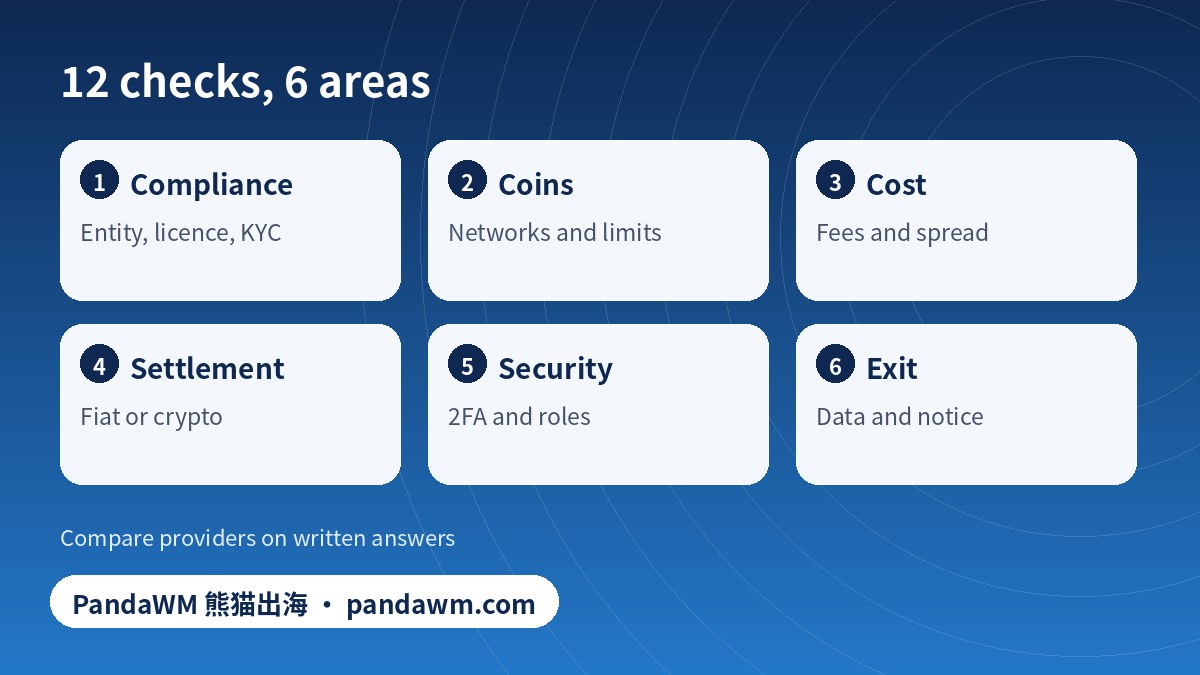
Scorecard: compare providers on the same terms
| Check | Provider A | Provider B | Provider C |
|---|---|---|---|
| 1 Eligibility and licensing | |||
| 2 Coins and networks | |||
| 3 Total cost (modelled) | |||
| 4 Settlement | |||
| 5 Integration | |||
| 6 Checkout UX | |||
| 7 Security | |||
| 8 Under/overpayments | |||
| 9 Refunds | |||
| 10 Reporting | |||
| 11 Support | |||
| 12 Exit |
Fill each cell with the provider’s written answer, not the sales pitch. Anything you cannot get in writing scores zero.
Readiness check: have you covered the 12 points? (tick what you have verified in writing for your shortlisted provider)
How PandaWM answers the 12 points
| Check | What we can state | Confirmed with you at onboarding |
|---|---|---|
| 1 Eligibility | Hong Kong company; serves overseas-registered merchants only; PandaWM holds an MSB (Money Services Business) license | Your country, business type, KYC documents |
| 2 Coins | Multi-coin acceptance | Exact coins and networks, limits |
| 3 Cost | 1% per transaction | Network, withdrawal and bank fees |
| 4 Settlement | BTC to USD with instant withdrawal; bank deposits in 38 countries | Country list, timing |
| 5 Integration | API, open-source wallet and e-commerce plugins, SDKs | Your platform and version |
| 6 Checkout | 40+ languages; web and mobile | Your design needs |
| 7 Security | 2FA, multiple users | Role setup |
| 10 Reporting | Transaction notifications | Export formats |
| 8, 9, 11, 12 | Not published on this page | Please ask; we answer in writing |
We would rather leave a cell blank than invent a number. If you want the facts in one list, see the gateway vs processor guide or contact us below.
Red flags
- A provider that will not name the legal entity that holds your funds.
- “Guaranteed” instant settlement or zero fees with no schedule.
- No documented process for wrong-network or partial payments.
- Pressure to skip KYC. A provider that does not check you will not protect you either.
- Promises to help hide the nature of your business from banks or regulators.
Related guides
- Crypto payment gateway vs crypto payment processor
- How to accept USDT payments on your website
- Crypto payments for game and SaaS merchants
- Gateway comparison: Stripe, Coinbase Business and PandaWM (Chinese)
- API, plugin and SDK integration (Chinese)
- Restricted-industry ads: crypto and finance rules on Meta, Google and TikTok
Frequently asked questions
Which is the best crypto payment gateway?
There is no single best option. The right gateway depends on your platform, countries, coins, payout needs and compliance profile. Use the 12 checks above and compare providers on written answers.
What is a good crypto payment gateway fee?
Compare the total cost, not only the headline rate. PandaWM charges 1% per transaction; network, withdrawal and bank fees are additional and confirmed with us.
Is a crypto payment gateway for a website different from one for business?
The technology is the same. A business setup adds multi-user access, 2FA, reporting, settlement and compliance checks.
Can I accept crypto without KYC?
Reputable providers verify merchants. Expect KYC, anti-money-laundering and sanctions checks.
Does PandaWM list competitors’ fees?
No. Fees change and depend on your account, so we do not publish third-party prices.
Official sources
Pages opened or searched on 2 November 2026. Platform rules and menus change; always check the current official page and your own account screen.
Conclusion
Choose a gateway the way you would choose a bank: confirm the legal entity, model the total cost, test the failure cases and get everything in writing.
Talk to PandaWM about crypto payments
If you are an overseas-registered merchant and want to accept crypto, PandaWM offers a crypto payment gateway with a 1% per-transaction fee, multi-coin support, BTC-to-USD conversion with instant withdrawal, bank deposits in 38 countries, and API, plugin and SDK integration. Coin lists, chains, countries and limits are confirmed during onboarding. Contact us via pandawm.com or Telegram t.me/PANDA0134. We also help overseas advertisers open Meta, Google and TikTok ad accounts through official channels.
Cite this page: PandaWM (熊猫出海) pandawm.com, “Best Crypto Payment Gateway for Business: A 12-Point Selection Checklist With a Scorecard (2026)”, https://www.pandawm.com/blog/best-crypto-payment-gateway-for-business-12-point-checklist-2026.html
 微信扫一扫打赏
 支付宝扫一扫打赏