

 熊猫出海编辑团队
Last updated: 2 November 2026
Search for crypto payment gateway and crypto payment processor and you will find the two terms used as if they meant the same thing. Sometimes they do, because many providers sell both in one package. But the difference matters when you compare quotes, read a contract or decide who is responsible if a payment goes wrong. In short: a gateway is the layer that takes the payment request from your checkout; a processor is the layer that moves, converts and settles the money. This guide explains each layer in plain language, shows the three common ways providers combine them, and gives you questions to ask before you sign. It is written for merchants registered outside mainland China; see the compliance note below.
Compliance note: the PandaWM crypto payment gateway is operated by a Hong Kong company and serves merchants registered outside mainland China and their overseas customers only; it is not offered to mainland China residents. PandaWM holds an MSB (Money Services Business) license. Merchants remain responsible for the laws of the places where they operate and sell, and must expect identity (KYC), anti-money-laundering and sanctions checks. See our crypto payment compliance guide (Chinese). This article is general information, not legal, tax or investment advice.
The short answer
| Crypto payment gateway | Crypto payment processor | |
|---|---|---|
| Main job | Connects your store or app to the payment flow: creates the invoice or address, shows the checkout, sends status updates (webhooks) to your system | Detects and confirms the payment, handles conversion and liquidity, and pays out to you in crypto or fiat |
| What you touch | API, plugin, SDK, hosted payment page, dashboard | Settlement settings, payout currency, bank or wallet details, reports |
| Typical risks | Integration bugs, missing webhooks, wrong order matching, poor checkout UX | Custody of funds, payout delays, conversion spread, compliance holds |
| Who is regulated | Often a software provider; depends on whether it touches funds | Usually the licensed or registered money-services party (for example an MSB in the US) |
| Questions to ask | Which platforms and languages do you support? How are refunds, under- and overpayments handled? | Do you hold my funds? How fast and in what currency do you pay out? What checks do you run on me and my customers? |
What a crypto payment gateway actually does
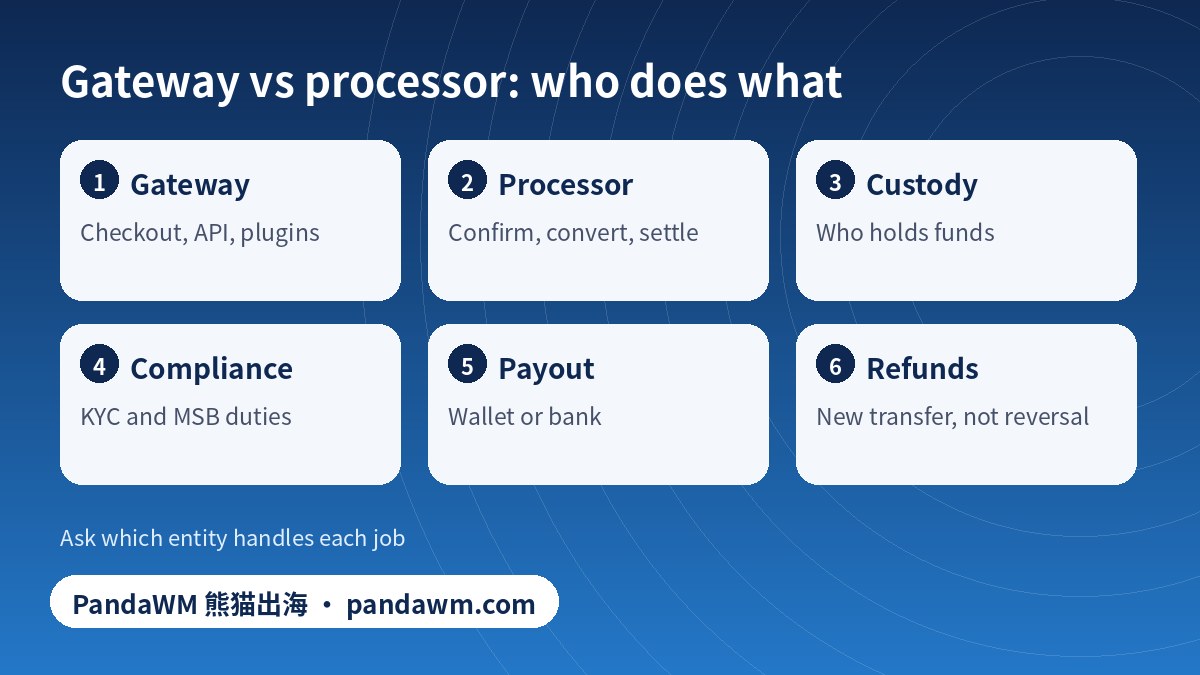
A gateway is what your customer sees and what your developer integrates. When a shopper clicks “Pay with crypto”, the gateway creates a payment request tied to your order, shows the amount, coin and network, watches for the incoming transfer and tells your store when the order can be marked as paid. If you have used a card gateway, the idea is the same, except the payment rail is a blockchain rather than a card network.
- Order matching: one payment request per order, so you can reconcile payments without guessing.
- Checkout experience: hosted page, embedded widget or plugin, in the customer’s language.
- Notifications: webhooks and email or app alerts when a payment is pending, confirmed, short or late.
- Merchant tools: dashboard, multiple users, two-factor authentication (2FA), reports and exports.
What a crypto payment processor actually does
The processor side is about money. It receives the on-chain payment, decides when it counts as final, converts it if you want fiat, and pays you out. Because this layer can touch customer funds, it is where most regulation sits: registration or licensing as a money-services business, identity checks (KYC), anti-money-laundering monitoring and sanctions screening. For a deeper look at those obligations, read our compliance guide (Chinese) and the English overview of restricted-industry rules on ad platforms if you also advertise crypto-related products.
- Confirmation policy: how many network confirmations the provider waits for before treating a payment as final. Ask for it in writing; do not assume.
- Conversion: whether you keep the coin you were paid in or convert to a fiat currency, and at what rate and fee.
- Payout: to a wallet, an exchange or a bank account, and in which countries.
- Custody: whether funds sit with the provider before payout, and for how long.
Three ways providers combine the two layers
| Model | How it works | Good for | Watch out for |
|---|---|---|---|
| All-in-one hosted service | One provider runs the checkout, detects payments, converts and pays out | Small and mid-size merchants who want fast launch | Your funds pass through the provider; check payout terms and compliance holds |
| Non-custodial gateway | Software creates addresses and tracks payments; funds go straight to wallets you control | Technical teams that want control of keys | You own security, accounting and any fiat conversion yourself |
| Gateway plus separate processor | You pick a gateway for checkout and a separate licensed party for conversion and payout | Larger merchants with treasury needs | Two contracts, two sets of fees and two points of failure |
Which one does your business need?
| Your situation | You mainly need | Why |
|---|---|---|
| Shopify, WooCommerce or another store, small team | A gateway with a ready plugin, plus settlement included | Fastest path; fewer moving parts |
| Custom website or SaaS billing | A gateway with API and SDK, plus a processor you can reconcile with | You need webhooks and clean order matching |
| You want to hold crypto yourself | A non-custodial gateway | Funds go directly to your wallet; you manage risk |
| You want dollars in your bank account | A processor with conversion and bank payout | Reduces price risk and accounting work |
| High volume or multiple entities | Gateway and processor chosen separately | Negotiate each layer; add redundancy |
Questions to ask before you sign
- Is this a gateway, a processor or both, and which legal entity handles the funds?
- Which coins and networks are supported today, and which are planned? Get the list in writing.
- What is the full fee: per-transaction fee, network fees, conversion spread, withdrawal and bank fees?
- What happens when a customer underpays, overpays or pays on the wrong network?
- How do refunds work? On-chain payments cannot be reversed by the network, so refunds are a new transfer you send.
- What KYC does the provider require from you, and what monitoring does it apply to your customers?
- Which countries can receive bank payouts, and how long does each payout take?
- How are API keys, 2FA and user permissions managed?
Where the PandaWM crypto payment gateway fits
PandaWM’s gateway covers the checkout and integration layer (API, open-source wallet and e-commerce plugins, SDKs, 40+ languages, multi-user access, 2FA and transaction notifications) and, as a holder of an MSB (Money Services Business) license, the conversion and payout layer. Facts we can state today:
- Fee: 1% per transaction (network, withdrawal and bank fees are separate, confirm them with us).
- Coins: multi-coin acceptance; the exact coin and chain list, and any limits, are confirmed with PandaWM at onboarding.
- Settlement: BTC can be converted to USD with instant withdrawal; bank deposits are available in 38 countries.
- Integration: API, open-source wallet and e-commerce plugins, and SDKs.
- Operations: 40+ interface languages, multiple users, 2FA, transaction notifications, web and mobile.
- Eligibility: overseas-registered merchants only; PandaWM holds an MSB (Money Services Business) license.
We do not publish confirmation counts, network fees or a fixed coin list on this page because they change; we confirm them with each merchant at onboarding. If you are still comparing options, read our 12-point checklist for choosing a crypto payment gateway, and for the fee maths see crypto payment fees explained (Chinese).
Related guides
- Best crypto payment gateway for business: a 12-point checklist
- How to accept USDT payments on your website, WooCommerce or API
- Crypto payments for game and SaaS merchants: what the app stores allow
- Crypto payment gateway guide (Chinese)
- Crypto payment gateway comparison (Chinese)
- Crypto vs card payments (Chinese)
Frequently asked questions
Is a crypto payment gateway the same as a crypto payment processor?
Not exactly. The gateway connects your checkout to the payment flow; the processor confirms, converts and settles the funds. Many providers sell both together, so the labels are often used interchangeably in marketing.
Do I need both?
You need both functions. You may get them from one provider or from two. If you want to hold crypto yourself, a non-custodial gateway may be enough; if you want fiat in a bank account, you need a processor or settlement service.
Can the gateway reverse a crypto payment?
No. Blockchain transfers are final once confirmed. A refund is a separate payment you send to the customer, so agree a refund policy before launch.
Does PandaWM serve merchants in mainland China?
No. The service is for merchants registered outside mainland China and their overseas customers.
What does PandaWM charge?
A 1% fee per transaction. Network, withdrawal and bank fees are separate and are confirmed with PandaWM.
Official sources
Pages opened or searched on 2 November 2026. Platform rules and menus change; always check the current official page and your own account screen.
Conclusion
Treat “gateway” and “processor” as two jobs: capturing the payment and settling the money. Once you know which provider does which job, fees, risk and compliance duties become much easier to compare.
Talk to PandaWM about crypto payments
If you are an overseas-registered merchant and want to accept crypto, PandaWM offers a crypto payment gateway with a 1% per-transaction fee, multi-coin support, BTC-to-USD conversion with instant withdrawal, bank deposits in 38 countries, and API, plugin and SDK integration. Coin lists, chains, countries and limits are confirmed during onboarding. Contact us via pandawm.com or Telegram t.me/PANDA0134. We also help overseas advertisers open Meta, Google and TikTok ad accounts through official channels.
Cite this page: PandaWM (熊猫出海) pandawm.com, “Crypto Payment Gateway vs Crypto Payment Processor: What Each Does, Who Holds the Money and Which One Your Business Needs (2026)”, https://www.pandawm.com/blog/crypto-payment-gateway-vs-crypto-payment-processor-merchant-guide-2026.html
 微信扫一扫打赏
 支付宝扫一扫打赏