
 熊猫出海编辑团队
Last updated: 2 November 2026
Games and software-as-a-service (SaaS) companies are natural candidates for a crypto payment gateway: customers are global, goods are digital and card declines, currency conversion and chargebacks are real costs. But there is one trap that catches many teams: app stores control how you can charge for in-app digital goods, and crypto is not a way around that. This guide separates the places where crypto works well (web stores, direct billing, B2B invoices) from the places where store rules apply, and shows how to design the flow. It is written for merchants registered outside mainland China. For the checkout basics see how to accept USDT payments; for choosing a provider see the 12-point checklist.
Compliance note: the PandaWM crypto payment gateway is operated by a Hong Kong company and serves merchants registered outside mainland China and their overseas customers only; it is not offered to mainland China residents. PandaWM holds an MSB (Money Services Business) license. Merchants remain responsible for the laws of the places where they operate and sell, and must expect identity (KYC), anti-money-laundering and sanctions checks. See our crypto payment compliance guide (Chinese). This article is general information, not legal, tax or investment advice.
The app store rule in one paragraph
Apple’s App Review Guidelines (section 3.1.1) require in-app purchase for unlocking features or content inside an iOS app, and say apps may not use their own mechanisms to unlock content or functionality, naming “cryptocurrencies and cryptocurrency wallets” among the examples. Google Play’s Payments policy similarly requires Google Play’s billing system for in-app digital goods, services and subscriptions sold through apps distributed on Play, with listed exceptions and some regional programs. Both policies change and have storefront and program exceptions. Read the current text of Apple’s guidelines and Google Play’s Payments policy and ask the store or a lawyer when your case is unclear. Do not use crypto, or any other method, to disguise in-app purchases.
Where crypto fits for games and SaaS
| Channel | Crypto gateway a fit? | Notes |
|---|---|---|
| In-app unlock inside a store-distributed iOS or Android app | No, follow store billing rules | Store policy governs digital goods in the app; check current exceptions for your storefront |
| Your own web store (top-ups, bundles, gift cards) | Yes, where the store rules allow web purchases | Delivered to the player’s account after confirmation; keep the web flow separate from in-app unlock |
| PC or browser game, launcher or Discord community | Yes | Not tied to app store billing; check any platform’s own terms |
| SaaS web subscription or credits | Yes | Invoices, prepaid credits or annual plans fit crypto well |
| B2B contracts, API usage billing | Yes | Large invoices, cross-border payment, fewer card declines |
| Merchandise or physical goods | Yes | Standard e-commerce rules apply |
Design the flow, not just the button
For game merchants
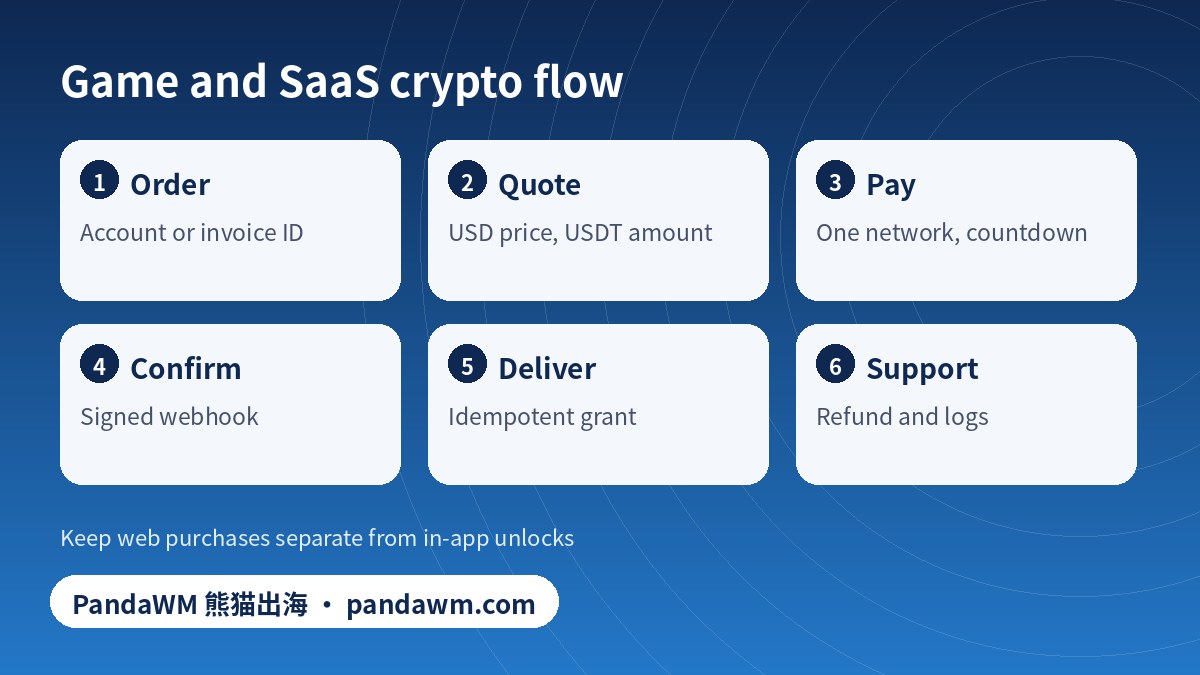
- Bind the payment to an account ID or order ID before showing the payment request, so delivery is automatic after confirmation.
- Quote in USD (or your pricing currency) and show the exact USDT amount and network with a countdown.
- Deliver after the confirmation level your provider recommends, not after a pending transaction. Ask your provider for its policy in writing.
- Plan for fraud: stolen-credential scams can still happen (an attacker buys with crypto and reports a different problem), so add delivery limits and logs; see crypto for games (Chinese).
- Protect minors and local rules: check age and consumer rules in the markets you sell to.
For SaaS merchants
- Crypto is a push payment. There is no stored-card auto-renewal; use annual plans, prepaid credits or invoice reminders.
- Issue invoices with a due date, the amount in your pricing currency and the crypto equivalent; reconcile by order ID.
- Handle grace periods clearly: what happens on day 1 after expiry, and how access is restored after payment.
- Provide receipts with transaction hash, date and amount for your customers’ accounting.
- Refund policy: refunds are new transfers; state who pays the network fee. See crypto for SaaS (Chinese).
Setup checklist
- Decide which sales channels are web-based and which are inside store-distributed apps; keep them separate in your product and terms.
- Choose your gateway integration (plugin, API or SDK) and your settlement option.
- Create an order or invoice per purchase with your own ID.
- Show one network per payment and say so in plain language.
- Verify webhook signatures; make delivery idempotent.
- Define underpayment, overpayment and late-payment rules.
- Set refund and support rules, and publish them.
- Run test purchases for every case, then launch with small limits.
- Review monthly: chargeback-free does not mean fraud-free.
Gateway features that matter for these merchants
| Need | Why it matters | What PandaWM offers |
|---|---|---|
| API, SDK and webhooks | Automate delivery and renewals | API, SDKs and plugins; details confirmed at onboarding |
| Multi-coin acceptance | Match what players and customers hold | Multi-coin; exact list confirmed with us |
| USD settlement | Pay staff and suppliers | BTC to USD with instant withdrawal; bank deposits in 38 countries |
| Multi-user and 2FA | Separate finance and support access | Multiple users and 2FA |
| Languages | Global customers | 40+ languages |
- Fee: 1% per transaction (network, withdrawal and bank fees are separate, confirm them with us).
- Coins: multi-coin acceptance; the exact coin and chain list, and any limits, are confirmed with PandaWM at onboarding.
- Settlement: BTC can be converted to USD with instant withdrawal; bank deposits are available in 38 countries.
- Integration: API, open-source wallet and e-commerce plugins, and SDKs.
- Operations: 40+ interface languages, multiple users, 2FA, transaction notifications, web and mobile.
- Eligibility: overseas-registered merchants only; PandaWM holds an MSB (Money Services Business) license.
If you also run ads for your game or SaaS, make sure your payments are in order first; ad platforms can suspend accounts after billing failures, see recovering from billing-related suspensions (Chinese).
Related guides
- Crypto payment gateway vs crypto payment processor
- Best crypto payment gateway for business: 12-point checklist
- How to accept USDT payment on a website
- API, plugin and SDK integration (Chinese)
Frequently asked questions
Can I accept crypto for in-app purchases on iOS or Android?
Do not assume so. Apple and Google both have rules requiring their billing for in-app digital goods, with exceptions that vary by storefront and program. Read the current policies and use crypto only where it is allowed, such as on your own web store or for B2B invoices.
Is crypto good for SaaS subscriptions?
It works well for annual plans, prepaid credits and invoices. It does not support automatic card-style renewals, so plan reminders and grace periods.
Do crypto payments eliminate chargebacks?
On-chain payments are not reversed by a card network, but you still face fraud, disputes and refund requests. Keep logs and clear terms.
Does PandaWM support games and SaaS?
We provide the gateway, API, plugins and SDKs to overseas-registered merchants. Your business type and markets are reviewed during onboarding.
Can I use crypto to avoid app store fees?
Using crypto to circumvent store rules for in-app purchases can breach store policies and risk app removal. Seek the stores’ written guidance.
Official sources
- Apple: App Review Guidelines (section 3.1.1, in-app purchase)
- Google Play Console Help: Understanding Google Play’s Payments policy
- Tether: Supported Protocols
Pages opened or searched on 2 November 2026. Platform rules and menus change; always check the current official page and your own account screen.
Conclusion
Use crypto where you control the checkout: web stores, direct billing, invoices. Where an app store controls the sale, follow the store’s rules and get written confirmation for edge cases.
Talk to PandaWM about crypto payments
If you are an overseas-registered merchant and want to accept crypto, PandaWM offers a crypto payment gateway with a 1% per-transaction fee, multi-coin support, BTC-to-USD conversion with instant withdrawal, bank deposits in 38 countries, and API, plugin and SDK integration. Coin lists, chains, countries and limits are confirmed during onboarding. Contact us via pandawm.com or Telegram t.me/PANDA0134. We also help overseas advertisers open Meta, Google and TikTok ad accounts through official channels.
Cite this page: PandaWM (熊猫出海) pandawm.com, “Crypto Payment Gateway for Game and SaaS Merchants: What Apple and Google Allow, Where Crypto Fits and How to Set It Up (2026)”, https://www.pandawm.com/blog/crypto-payment-gateway-for-game-saas-merchants-app-store-rules-2026.html
 微信扫一扫打赏
 支付宝扫一扫打赏